
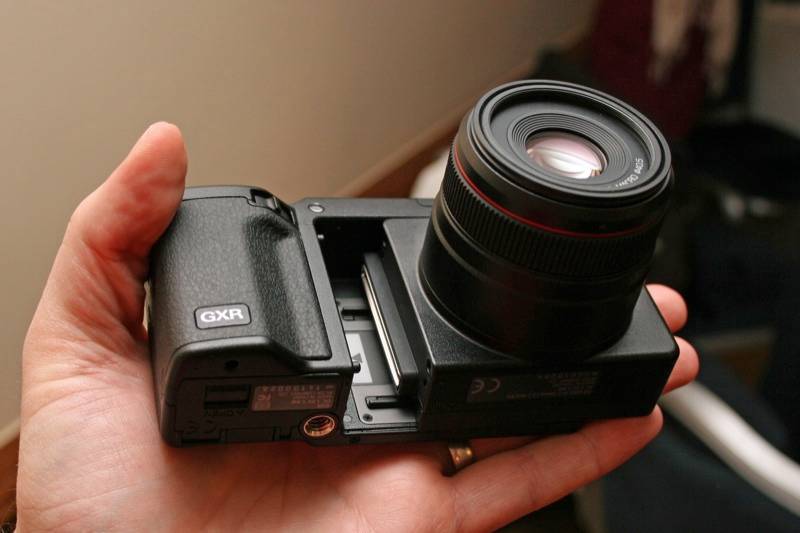
Ricoh's brave new release in the GXR is a camera of two halves - literally. With the intention of providing a photographic "solution" that will take digital SLR-like professional quality photographs whilst, unlike a DSLR, being small enough to fit in your pocket, the basic GXR component comprises a camera back replete with high resolution 3-inch LCD screen, operational controls including a shooting mode dial, grip, pop-up flash, plus battery and card compartments.
Our quick take
Ricoh has come the closest yet to delivering DSLR-like quality and versatility in compact form, though the GXR is still too tight a squeeze for a trouser pocket with or without its lens combos attached.
Plus the high price of initial set up may have all but the most ardent photo enthusiast waiting until the cost comes down.
But if you do have sufficient funds, for camera nuts this will be a dream come true.

Ricoh GXR digital camera - 4.5 / 5
| FOR | AGAINST |
|---|---|
|
|
Onto the front of this slides a separate boxy unit comprising sensor, lens and image processor. Locking tight with a satisfyingly sturdy "clunk", when combined the two halves resemble a rather conventional looking whole. In fact, like most of Ricoh's range, the otherwise utilitarian styling of the GXR makes it seem like it was put together in a Russian car plant during the Cold War.
Yet, defying the previously tried and tested, Ricoh's GXR is presently the only digital camera on which both lens and sensor can be changed in tandem to best suit any given subject, meaning the concept is a revolutionary, bang up-to-date, one.

Ricoh's definition for the GXR is "interchangeable unit camera system", which, while it doesn't exactly trip off the tongue, at least attempts to get to the crux of the matter. Because there's no sensor in the body, the manufacturer argues that its system is expandable like no other, and adds that the idea is currently patented for Ricoh alone, so we're unlikely to see copycat devices for the time being. Both units feel rugged, weighed up individually in the palm and when combined, being of solid-feel magnesium alloy construction like a proper mid-range DSLR. This is, theoretically, a camera that should provide years of service.
Aiming to do battle with the not quite so compact "hybrid" interchangeable lens competitors in Olympus' E-P1, E-P2 and Panasonic GF1, there are presently two swappable lens and sensor combos - or "camera units" - available for the GXR body.
These are a 50mm close up (macro) lens combined with an APS-C sized sensor as found in entry to mid-level DSLRs, making it adept at shooting sharp portraits with attractively defocused backgrounds, plus a 24-72mm (3x) zoom coupled with a 1/1.7-inch CCD sensor as found in Ricoh's flagship GR Digital III compact, a fixed lens alternative.
The two units differ further regarding the resolution offered: 12.3 effective megapixels from the 12.9MP CMOS sensor coupled with the 50mm lens, and 10 effective megapixels from the 10.4MP CCD wedded to the zoom.
Whilst the 50mm option seems to make the most of the GXR's "DSLR in compact form" potential and for us provides the most professional in appearance pictures, the zoom proves to be the no brainer option for those wanting a jack-of-all-trades set up.
Not just the kind of images created but also which features and functions users can get access to alters when attaching differing lens units.

To take one example, in attaching the zoom lens and CCD sensor pairing the user has access to 640 x 480 pixels video. Swap this for the fixed 50mm alternative and resolution jumps to an HD Ready 1280 x 768 pixels, at standard 24 frames per second. While such options are selected via the camera's on-screen menus, they are presented in small narrow type and we found ourselves tabbing through three screens crammed with information to find essential features we wanted at-a-glance, such as light sensitivity/ISO settings.
Fortunately for us then Ricoh has implemented a time saving "Direct" button top left of the LCD at the back that, when pressed, displays a collective overview of the current key settings the user has selected as simplified icons on-screen. Each icon can be highlighted in turn and then the particular setting of that function individually tweaked, saving the need to have to go back and dig through the menu screens as required initially. So though not the most intuitive to use at first, with a bit of familiarity operation of this Ricoh gradually speeds up.
Otherwise the GXR's approach is a slightly more leisurely than a DSLR, and you get the feeling that, as with Sigma's high-end fixed lens DP2 compact and Ricoh's own GR III alternative, it's the more considered user who will reap the greatest reward from the GXR. A case in point: it takes 3 seconds to power up for the first shot from cold. Whilst the common creative quartet of program, shutter priority, aperture priority and manual shooting modes are provided for the more experienced user, beginners (or the plain lazy) can get photographing straight away courtesy of a regular automatic shooting mode found next to them.
Further offered is a Scene Mode setting that gives access to not only video capture - which on most other compacts would have its own obviously separate mode - but also pre-optimised portrait, landscape, sports, night scene, and skew correct (perspective correction) setting. There are three further custom modes found on the same dial, to which photographers can attribute their preferred settings for, once again, faster access.
With the 50mm lens and 12MP sensor unit attached the GXR comes into its own in delivering stunning portraits and detail-rich close ups, though low light and/or busy scenes can stymie the auto focus, prompting us to instead reach for use of the deftly-provided manual focus ring. It can also help to take control of white balance settings, particularly when artificial tungsten light gives any scene an orange wash if left on auto.
The camera doesn't command attention in the same with zoom lens and 10MP sensor attached - a physically smaller overall set up than the fixed lens alternative - but then this is the "everyday" option adaptable to taking photographs of a wide range of subjects.
So who is the Ricoh GXR and its two different lens/sensor/processor options aimed at?
The manufacturer says not just its traditional audience of middle-aged male enthusiasts, but also women and 20- to 30-somethings who likewise want a device that will take great quality pictures but still slip into a handbag or jacket pocket.
Optional accessories include an electronic viewfinder (EVF) that clips onto the camera's hotshoe for creative flexibility - it can for example be angled straight up so the user can compose images looking down, as on a medium format camera, plus flashgun that attaches in the same way, meaning both cannot be used at the same time.

Aside from getting people to buy into a new concept, the biggest potential hurdle for the GXR is the suggested retail price, which at the time of writing is around £420 just for the GXR body. With the 50mm bolt-on option costing a further £599 and the 24-72mm alternative £329, early adopters are looking at an initial outlay of either £749 or £1,018 before a single image can be captured. Yes, that’s as much, if not more, than a semi professional digital SLR.
But then Ricoh's GXR is a different beast and isn't going to be bought by anyone as their one and only digital camera. It will work best as a much better quality alternative to carrying around a point and shoot compact and as an almost-as-good alternative to a DSLR proper for enthusiasts and semi pros wanting a back up for their bulkier device.
To recap
Ricoh has come the closest yet to delivering DSLR-like quality and versatility in compact form, though the GXR is still too tight a squeeze for a trouser pocket with or without its lens combos attached