
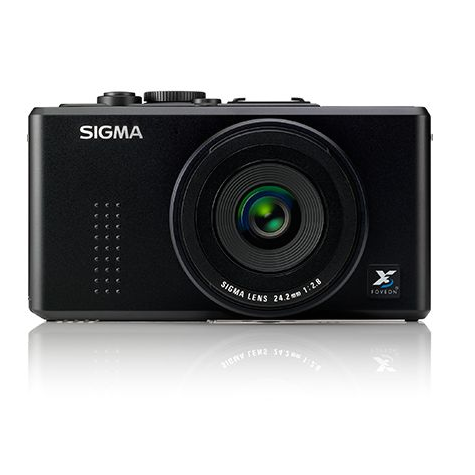
Best known for its excellent lenses, Sigma continues to plough a unique furrow when it comes to the sensors placed in its DSLRs and compacts; in the case of the DP2, which logically follows the DP1, a triple layered Foveon X3 chip.
The different layers record different colour information, with one layer each for red, green and blue. The result? Truer to life results, says Sigma, with an almost three-dimensional quality.
Sigma’s sensor is also physically larger than those traditionally found in digital compacts. At dimensions of 20.7 x 13.8mm it’s closer to the ones typically found in a DSLR. A larger sensor in theory equates to better image quality, so its manufacturer is claiming that sensor and fixed lens combined will deliver "all the power of DSLR".
It’s a lofty claim, and one that goes partly towards justifying the DP2’s eye-watering price. For nearly £600, one could of course buy an actual DSLR and standard zoom setup.
And while the DP2 may indeed be a compact camera, it’s still larger than a conventional pocket model. The fact that its lens barrel isn’t ever flush to the body means that at a weight of 260g without rechargeable battery (good for a so-so 250 shots) and SD or SDHC card, it’s one for the deeper jacket pocket or camera bag.
Images are composed and reviewed via a 2.5-inch, 230k dot resolution LCD screen (not quite top DSLR spec) in the absence of an optical viewfinder, prompting the need to cup a hand around the monitor to view it properly in sunny conditions.
There’s no zoom here either, rather a 24.2mm fixed Sigma lens equivalent to 41mm in film 35mm terms, most suitable for snapshots and portraits with a large aperture of F2.8. In addition Sigma has managed to shoehorn a pop-up flash, hotshoe for accessory bulb, plus a manual focus dial into the camera’s unfussy top plate.
Held in the palm, with a strip of raised nodules front and back aiding grip in the absence of any conventional alternative, the DP2 feels solid yet quite plasticky; its square edged, no-nonsense design won’t win any style awards. Like Olympus’ recent E-P1, also making a claim for being a DSLR in more compact "clothing", it’s decidedly retro.
In terms of response and handling the camera powers up from cold in a couple of seconds, lens fully extending and rear LCD blinking into life. Shooting settings are selected via a familiar top plate mode dial, with the creative options of program, shutter priority, aperture priority and manual modes alongside video (at a internet friendly 320 x 240 pixels only) plus setup and voice memo functions.
Indicating that this is a bit of kit for more serious photographers, there’s no full auto here. In fact little concession has been made to user friendliness; navigating the busy on-screen menus takes time to familiarise yourself with and in practice the shutter button is a tad stiff; so much so that it was only the sand timer icon appearing on screen that alerted us to the fact a shot had actually been taken. Auto focusing is also surprisingly sluggish at first.
Once downloaded to the desktop, a quick examination of File Info in Photoshop reveals that each image in fact contains "only" 4.6 megapixels worth of information. While that may be a surprise for anyone with eyes fixed on the headline sensor specification of a total 14 megapixels, said images in fact resemble the equivalent of those from an 8- or 10-megapixel camera – such is the level of impressive detail delivered by the fixed lens. Maximum resolution, fine quality JPEGs take a couple of seconds to write to memory, RAW files a fraction longer.
RAW images are processed using the Windows and Mac compatible Sigma Photo Pro software CD supplied in the box. The look of the Sigma’s images has been described as film-like, and certainly they have a look of their own that will divide opinion.
Unadulterated pictures appear under-saturated, or certainly less well saturated than we’re used to seeing from digital images processed in-camera, plus on occasion we had trouble with colour casts, although manually adjusting white balance sorted this out. For anyone who has complained that digital images look a bit too sharp, the camera is worthy of further investigation – but we were disappointed when our review sample inexplicably froze on a couple of occasions. Removing and re-inserting the battery righted that particular wrong.
Our quick take
Because of the limitations of a fixed lens (as opposed to a zoom), using the DP2 over a period of time begins to change the way that you shoot. The only "zoom" option you have is simply to take a few steps forward, so framing is more considered, you find yourself planning shots in advance.
In this respect it’s almost like returning to the days of film, when every image cost you money, so you naturally slowed down and took your time. Gradually, the fact that the AF is slow doesn’t begin to grate nearly so much.
This isn’t however a model that you can expect to get excellent results from straight out of the camera, with shots that require a narrow depth of field, blurring the background, working best. So unless you’re prepared to put in a bit of time in post-production, then this is not the camera for you. However, with a bit of time and patience in Photoshop we were able to achieve pleasing results.
That said, because of its intended limitations and presumably unintended operational quirks, we wouldn’t recommend anyone bought a Sigma DP2 as their one and only digital camera; it works best when viewed as a compact back-up to an existing DSLR, or an experimental supplement to a more fully-featured, user-friendly digital compact.
OK, so it’s a good thing that one manufacturer is attempting to split from the pack and try something different to the rest, but as such, the DP2 finds itself occupying a particularly narrow – and pricey – niche.

Sigma DP2 digital camera - 3.5 / 5
| FOR | AGAINST |
|---|---|
|
|
To recap
The Sigma DP2 won’t appeal to everybody, and that’s largely by design. It works best when viewed as a compact back-up to an existing DSLR, or an experimental supplement to a more fully-featured, user-friendly digital compact