
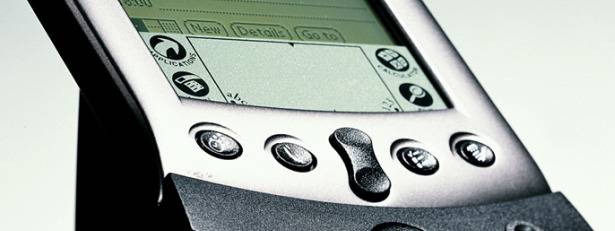
Back in 1996 a small division of US Robotics came up with a personal digital assistant portable pad that ran a touchscreen controlled OS on 128KB memory and just a serial port for connecting it to the rest of the world. So was invented the Palm 1000 - the very first PalmPilot.
Its four creators, Jeff Hawkins, Donna Dubinsky, and Ed Colligan, had been working on a handwriting recognition software called Graffiti when they realised that they could probably do a better job of the hardware over most manufacturers while they were at it to - and indeed they did. In little over 13 years and while switching between parent companies and independence, Palm has managed to push out over 50 different devices. For the non-mathematic, that's an average of around four per year. So, before you jump on into the Pre - now that it's finally hit the UK - or just in case any still loyal to the cult need a little reminding, here's how it went from a glorified notepad into multi-touch, multi-media bonafide iPhone killer.
The Palm Pilots (1996)
The first Palm models were the Palm 1000 and Palm 5000 both of which had no infra-red, no backlight and not even any flash memory to rely on for storage. In fact, all they really had was some neat touch software, a stylus and a serial connector, and the only difference between the two was that the 5000 had 512KB of RAM. Both ran the brand new, version 1 of the Palm OS and were later upgradeable to 1MB of memory. They relied on a memory slot under a flap on the back cover which could offer up to a whole 512KB of storage and it wasn't until the later PalmPilot Personal and PalmPilot Professional that the backlight was born. Nonetheless, the devices were a roaring cult success and the story had begun.
In 1998, legal action from Pilot Pens meant that PalmPilot was shortened to just Palm, but the name had already stuck with people and the word became synonymous with PDAs. The Palm III and slightly higher spec Palm V series were next out the blocks with the third version of the Palm OS and starting with a 16MHz processor, 2MB of RAM and, at last, some flash memory, a backlight solution and an IR port too. The first few ran on AAA batteries and relied on 10 or 15 minutes of emergency power while you changed them over in order not to lose all your data. Mercifully, they added the Li-ion solution from the Palm V onwards.
Colour screens also popped up as did the ever popular hardware expansion slot, a glut of tools and apps and even a little wireless internet connectivity, if only for users in the US. By 1999 though, the founders had had enough of the new parent company, 3com, and moved on to a venture of their own - the first Palm OS licensed business known as Handspring.
Handspring Visor (1999)

The Visor series was the first to support Macs out the box. They had USB connections, solid state electronics and were more mass market focused with bright colours and a more appealing form factor. They ran on 33MHz chips and housed the Springboard expansions slot which was used for adding games or eBooks, GPS, a camera, a TV remote or pretty much any hardware you liked. Its versatility and durability made the series a huge hit and still had a large cult following until 2002 when the products finally ceased.
Palm m100 series (2000)

In the mean time, the original Palm company had become Palm Inc and it merged with Hanspring to form PalmOne - the hardware branch of the operation - while PalmSource still existed externally to work on the software. Deciding that there was still plenty more consumers to reach, the company created the Palm m100 series or entry level PDAs with cheap, non-metallic cases; smaller, plastic screens with hinged covers and they ran on non-rechargeable batteries. They started with a small step back to a 16MHz processor and 2MB of RAM and eventually included a cradle, USB instead of serial and an SD card slot too.
Palm m500 series (2001)
It was the slightly more luxury m500 series where it was at though, which lavished the user in all the areas that the m100s just didn't. They had metal cases, faster 33MHz CPUs, new software, better USB connections and even a vibrating alarm clock. They were essentially the replacement for the old Palm V. Later models had SD cards slots and eventually colour screens too.
Zire (2002)

The success of the two tiered system continued into 2002 when it inspired both the Zire and Tungsten ranges. The Zire took over from the more budget m100. They were consumer grade PDAs with the lower end models under $100 and heavily focused on achieving cheaper price points, and the higher end version all about multimedia use with the additions of a camera and MP3 player. They were monochrome, had no backlight and ran 126MHz processors backed up with either 8MB or 16MB of RAM. Again, the devices had a huge cult following but the last of the series came soon enough in the shape of the Zire 72 rather than the 73, which was falsely rumoured after Buy.com accidentally put the wrong label next to one of the Tungsten models.
Tungsten Series (2002)

For the business focused, the prosumer or, essentially, those with the passion and the cash to spare, the parallel Tungsten series were the higher spec models. They featured a business class version of the Palm OS and had metal cases, 65,536 colour LCD screens with 320 x 320 pixel resolution and had both Bluetooth and Wi-Fi. They never came with a camera but all the rest of the trimmings were there with much better ARM processors at up to 400MHz speeds, 64MB of RAM and mini USB. Their success ran them right through until 2005 when the rise of the smartphone caused Palm to get experimental.
Treo Smartphones (2002)
Realising that connectivity was the key to their success, Palm fused their PDA ideology with that of a mobile phone to create the Treo range of smartphones. These communication centric devices dropped the hardware expansion ports to save space but mostly came with keyboards and stubby ariels and were deemed a success, offering the kind of extra range of technology associated with the brand, such as being some of the first quad-band units available. A few models are still around today - although rather more sleek looking - but will likely be almost entirely replaced by Palm's new efforts in this space.
LifeDrive (2005)
The first of Palm's two less successful experiments was the LifeDrive, which was the company's only attempt at this kind of larger complete mobile manager system designed for all your needs. To talk of it now with its contacts, calendar, music, images, video, applications, 4GB of microdrive HDD storage, Bluetooth and Wi-Fi, plus all the software from the Palm OS, it doesn't sound too dissimilar to modern smartphones and generally like a pretty good idea. It even had a switch to change the view from portrait to landscape mode. The trouble was that, at the time, all of that made it a very large, very expensive device. Production was ended less than 2 years into the cycle, not long before others got the same but more refined idea.
Foleo (2007)

The other product just a fraction ahead of its time was the Palm Foleo - the company's one and only foray into the laptop world. It was announced at the end of May 2007 as a 10.2-inch Linux-based computer designed to be a companion for smartphones. It had a 416MHz CPU, 128MB RAM, 256MB of flash storage and featured the Opera browser as well as the Palm Documents To Go office software. Naturally, it was both Bluetooth and Wi-Fi connected but, most interestingly of all, claimed to have an instant-on feature which brought up the apps and desktop in exactly the same state as you left them when it booted up. Its major downfall was that it only supported the Treo, but that didn't matter anyway as it never came to market. It was dropped by the end of September that year. Lucky old Asus.
Centro (2007)

The last Palm device brought out to actually feature the Palm OS was the compact Palm Centro. It was designed as a condensed version of the Treo for mass market appeal, much as the Pearl works for BlackBerry. It has a 1.3-megapixel camera with 2x digital zoom, a 320 x 320 65k colour touchscreen, a full QWERTY and up to 4GB of storage thanks to a microSD slot. The phone was a storming success for Palm and accounted for the lion's share of the company's mobile internet traffic, as well as that for the US in general when it first came out. It's since given way as new smartphones have arrived but continued to impress even in 2008.
Pre (2009)
So, finally here we are today with the Palm Pre. It's seemed like donkey's years since CES 2009 with those in the US waving the things at us from across the Pond, but the wait is finally over. There was a large, collective sigh of disappointment as O2 was unveiled as the exclusive carrier for the device and its inevitable iPhone-matching price point, but nonetheless it's still a very exciting prospect. The multi-touch and gesture controlled webOS has taken over from the old software, there's still a full QWERTY plus GPS, a decent looking camera, plenty of storage and even iTunes synching too - no matter how much Apple is trying to shake it off. Perhaps the one draw back are the apps, or serious lack of them, but of the 18 or so from release, one is a Classic Palm OS emulator, so, if you want, you can run thousands of old school pieces of software dating right back to the 90s. Not a massive plus but certainly a little nostalgia for the enthusiasts.
Pixi (2009?)
But the story doesn't end there. Soon from the Palm stables will be the light version of the Pre known as the Palm Pixi. It was announced in September and should be out before the end of the year. If the Pre can turn enough eyes, then Pixi should be able to capitalise on those who aspire but can't quite afford the top level of smartphones. It still runs webOS with a touchscreen and QWERTY and only trims down here or there on the less essential items, rather than removing features completely. Harking back to the ethos of the Palm Centro it'll be interesting to see how it does and even more so to see if the Palm cult can finally hit the mainstream.